
Technical debt removal is the work of taking a business application that has become slow, fragile and expensive to change, and returning it to a state where it runs reliably and can be improved without fear. It is rarely glamorous. It is often the most valuable software work a growing company can commission, because the legacy system it repairs is usually the one the whole business depends on.
This article is for owners, operations directors and finance leads who have inherited an application that nobody fully understands: a stock system written years ago by a developer who has since left, an invoicing tool that crashes at month-end, a database that slows to a crawl as soon as two people use it. We explain how technical debt builds up, how to recognise it, and the step-by-step method we use to recover legacy codebases safely, without stopping the business that runs on them.
Key points
- Technical debt removal returns a slow, fragile legacy system to a state where it runs reliably and can change safely.
- A full rewrite is rarely the best first step; legacy code holds undocumented business rules.
- The method: written audit, urgent fixes, safe change, database work, then progressive restructuring.
- Each stage is priced in advance, and ongoing upkeep is monthly and cancellable.
Table of Contents
What technical debt actually is
The term was coined by the programmer Ward Cunningham to describe a simple trade-off. When a team ships code that works today but is harder to change tomorrow, it borrows time from the future. Like financial debt, that can be a sensible choice. And like financial debt, it charges interest: every later change takes longer, breaks more often and costs more. Martin Fowler’s short essay on technical debt remains one of the clearest explanations of the idea.
The interest is what hurts. A legacy application with heavy technical debt does not usually fail all at once. It fails a little more every month: a report that takes thirty seconds instead of three, an update that nobody dares to install, a bug that returns after each fix, a feature request that is answered with “that is not possible in this system”.
How it builds up in growing companies
In the businesses we work with, technical debt almost always comes from the same history:
- A quick first version. The application was built fast, often by one person, to solve an urgent problem. It worked.
- Growth on top of it. New sites, new users, new products and new rules were added as patches, each one reasonable, none of them planned together.
- The original developer left. Knowledge of how the system works left with them. Nothing was documented.
- Nobody owned it. Updates to the server, the language version and the libraries were postponed because nobody was sure what would break.
- Workarounds multiplied. Staff built spreadsheets around the system to compensate for what it could no longer do.
None of these steps is a mistake on its own. Together, they produce a system that the business cannot live without and cannot safely change.
Signs that technical debt removal is overdue
You do not need to read code to recognise heavy technical debt. The symptoms show up in daily operations.
Operational symptoms
- Screens and reports get slower as data grows, especially at month-end.
- The application crashes or freezes when several people use it at once.
- The same bugs come back after being fixed.
- Staff keep parallel spreadsheets because they no longer trust the system’s figures.
- A simple change, such as adding a field to an invoice, takes weeks or is refused.
Technical symptoms
- The application runs on a version of PHP, Java, .NET or a database that no longer receives security updates. For PHP, for example, the project publishes which versions are still supported on its supported versions page.
- There are no automated tests, so every change is tested by hand, or not at all.
- Backups exist but have never been restored to check that they work.
- Passwords and keys are written in the code.
- Nobody knows exactly which server the application runs on, or who has access to it.
Organisational symptoms
- One person, often an external freelancer, is the only one who can touch the system, and they are hard to reach.
- Every request for change starts with “we would need to rewrite everything”.
- Budget is spent every year on emergency repairs rather than improvements.
If you recognise three or more of these signs, technical debt removal is no longer optional. The question is only whether it happens in a planned way or after a serious incident.
The cost of postponing technical debt removal
Technical debt is easy to postpone because its cost is spread thinly across the business. Nobody receives an invoice for it. It shows up instead as hours lost and risks carried.
- Staff time. Every minute a clerk waits for a slow report, every spreadsheet kept in parallel, every figure checked by hand because the system cannot be trusted, is paid for in salaries.
- Lost revenue. Invoices that cannot be issued because the system crashed at month-end, or are issued late, delay cash collection.
- Opportunity cost. Projects the business wants, such as a customer portal, a new site or a mobile app for the field, are blocked because the core system cannot support them.
- Incident risk. An unsupported server or an unpatched library is an open door. A ransomware attack or a corrupted database without a working backup can stop operations for days.
Worked example: ten staff each losing twenty minutes a day to slow screens and workarounds add up to more than 70 hours a month. At an average loaded cost of 60 MAD per hour, that is over 4,000 MAD a month, every month, before counting any incident. The figures are illustrative, but they show why technical debt removal usually pays for itself faster than owners expect.
Rewrite or repair: the first decision
Faced with a legacy system, the tempting answer is to throw it away and start again. Sometimes that is right. More often it is a costly mistake, because the old system contains years of business rules that nobody wrote down: special prices for certain customers, exceptions for certain sites, rounding rules the accountant relies on. A full rewrite has to rediscover all of them, usually the hard way.
We decide case by case, using four questions:
| Question | Points towards repair | Points towards rewrite |
|---|---|---|
| Does the data model still match the business? | Yes, broadly | No, it fights the business at every step |
| Is the platform still supported or can it be upgraded? | Yes, with effort | No, it is a dead technology |
| Are the business rules documented anywhere? | No, they live in the code | Yes, or they are simple |
| Can the business tolerate a long parallel run? | No | Yes |
In most cases the answer is a progressive approach: stabilise what exists, then replace it piece by piece behind a stable interface. Martin Fowler describes this as the strangler fig pattern: new modules grow around the old system and take over its functions one at a time, until the old core can be retired without a risky big-bang switch.
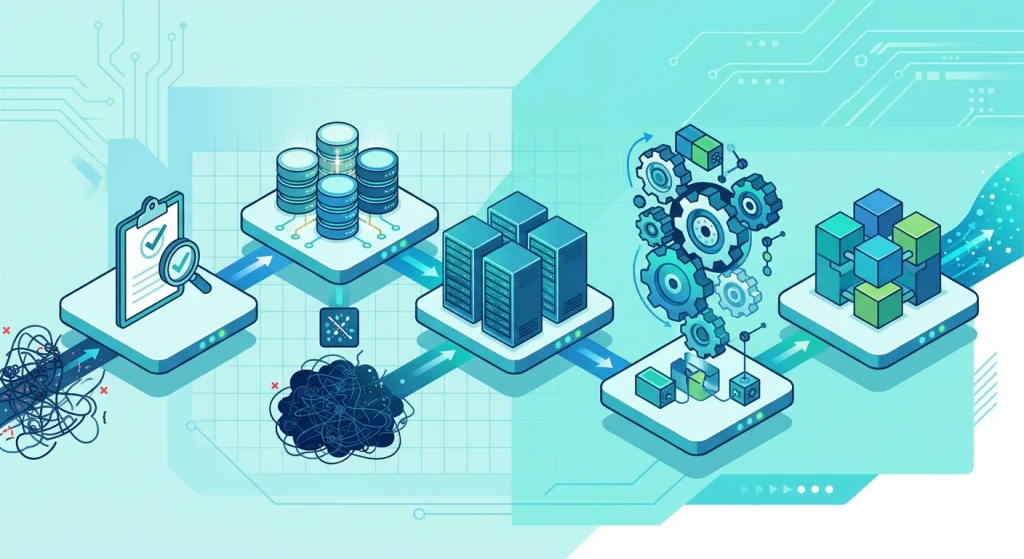
Our technical debt removal method
We follow the same five stages on every technical debt removal project. Each stage leaves the system in a better state than before, so the business benefits even if later stages are delayed.
Stage 1: a written audit
Before changing anything, we read. We review the code, the database, the server, the backups, the access rights and the way the system is used day to day. We talk to the people who use it and the person who last maintained it, if they can be reached.
The output is a written report in plain language, not a slide deck of jargon. It lists what we found, the risks in order of severity, what each fix would involve, and an estimate of cost. You can act on it with us or with anyone else. The audit is described on our technical management page.
Stage 2: stop the bleeding
Some risks cannot wait. The first fixes are always the same:
- Backups that restore. We set up automatic backups of the database and files, then restore them to a separate server to prove they work.
- Access cleaned up. Old accounts removed, shared passwords replaced, keys moved out of the code, administrative access limited to the people who need it.
- Critical security patches. Known vulnerabilities in the server, the language runtime and the libraries are patched, prioritised using references such as the OWASP Top 10.
- Monitoring. An alert is sent when the application goes down, when errors spike or when the disk fills up.
At the end of this stage, the system is no worse to use, but it is far less likely to cause a disaster.
Stage 3: make change safe
Technical debt removal stalls when every change is frightening, so this stage is never skipped. The next step is to make change safe:
- Version control. All code goes into a repository with a history, if it was not already.
- A copy of production for testing. A staging environment with anonymised data, where changes are tried before they reach users.
- Tests on the critical flows. Not full coverage on day one, but automated checks on what must never break: issuing an invoice, recording a delivery, calculating stock.
- Documentation. How to install, deploy and restore the system, written down so the next person is not starting from zero.
Stage 4: fix what hurts most
With a safety net in place, technical debt removal can address the audit’s priority list. In practice, the biggest gains usually come from the database.
- Indexes. Many slow screens are slow because the database has to read every row to find a few. The right index can turn a thirty-second report into a sub-second one.
- Query rewriting. Code that sends hundreds of small queries where one would do is rewritten.
- Archiving. Years of closed records are moved out of the tables used every day, while remaining available for reports.
- Upgrades. The language runtime, framework and database are upgraded to supported versions, step by step, with tests at each step.
- Recurring bugs. Each one is traced to its cause, fixed once, and covered by a test so it cannot return unnoticed.
Stage 5: restructure progressively
Only then do we restructure: separating tangled modules, replacing parts that cannot be saved, and moving towards a cleaner structure using the strangler approach described above. Each step is released on its own, tested in staging, and reversible.
What technical debt removal changes for the business
The results are operational, not cosmetic.
- Speed. Screens and reports that users had learned to wait for respond quickly again.
- Reliability. Month-end runs without a crisis. Crashes become rare and are detected before users report them.
- Security. The system runs on supported software, with access controlled and backups proven.
- Freedom to change. New requirements are estimated and delivered instead of refused.
- Independence. The system is documented and no longer depends on one person’s memory.
Worked example: an invoicing application whose month-end batch took most of a working day was found to run one database query per invoice line, with no index on the customer and date columns. Adding two indexes and grouping the queries reduced the batch to a few minutes. Cases like this are common; the figures here are illustrative of the kind of gain an audit can reveal, not a promise for any particular system.
Technical debt removal as an ongoing service
Technical debt is not removed once and for all. Every new feature, library update and change of business rule creates a little more. The difference between a healthy system and a legacy one is that the healthy system pays the interest regularly.
For companies without an internal IT team, we provide this as monthly technical management: updates applied, backups tested, monitoring watched, small fixes made and a short written report each month. The service can be cancelled at any time. For larger changes, we quote a fixed price before work starts, under our fixed-price model.
Security, data protection and technical debt removal
Legacy systems often hold personal data: customer names and telephone numbers, staff records, sometimes patient or guest information. In Morocco, the processing of personal data is governed by Law 09-08, overseen by the CNDP. A system running on unsupported software, with shared passwords and untested backups, makes it hard to show that this data is properly protected.
Technical debt removal is therefore also a data protection measure. Cleaning up access, encrypting connections, applying security updates and proving that backups restore are exactly the controls a data protection review will ask about. We document each of them in the audit and in the monthly report, so you have a written record of what was done and when.
How to prepare for an audit
You can speed up the first stage of technical debt removal by gathering what you have before the first meeting:
- Any access you hold to the server, hosting account, domain and database.
- Contact details of the previous developer or provider, if any.
- A list of the problems users complain about most, in their own words.
- Any documentation, even partial or out of date.
- The reports and documents the business cannot do without.
Do not worry if most of this is missing. Recovering systems with no documentation and no handover is a normal part of the work.
Questions about technical debt removal
What is technical debt removal?
Technical debt removal is the planned repair of a software system that has become slow, fragile or hard to change. It covers auditing the code and data, securing backups and access, upgrading unsupported software, fixing the root causes of recurring faults, and restructuring the system progressively so it can evolve safely again.
Should we rewrite our legacy system instead?
Sometimes, but rarely as a first step. A legacy system often holds years of undocumented business rules. A full rewrite must rediscover them all, with high risk. We usually stabilise the existing system first, then replace it piece by piece, so the business keeps running throughout.
How long does technical debt removal take?
The written audit typically takes one to two weeks. Urgent fixes such as backups, access and critical patches follow immediately. Deeper work on the database and structure is planned in stages over weeks or months, depending on the size of the system and the priorities set in the audit.
Can you work on a system someone else built?
Yes. Most recovery projects involve code written by someone else, often with no documentation and no handover. Reading and documenting unfamiliar systems is the first part of the work, and the written audit records what we found so you are never dependent on us alone.
How is the work priced?
The audit and each defined stage of work are quoted at a fixed price before they start. Ongoing maintenance is offered as a monthly technical management service that can be cancelled at any time. There is no open-ended hourly billing.
Next step
If your business depends on a system that nobody wants to touch, the first step is a conversation, not a rewrite. Describe the system and the problems you see, and we will tell you what an audit would cover. You can also read how we build custom systems when replacement is the right answer.
Written by Abdelmalek MESKIK, CEO | Founder & Chief Operating Officer (COO), MeskikCode.